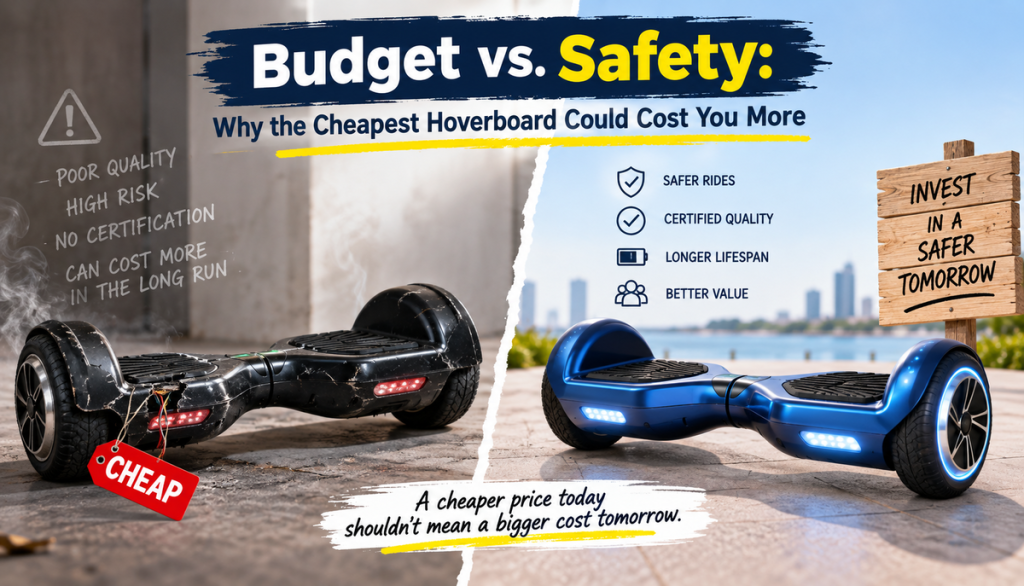

Budget vs. Safety: Why the Cheapest Hoverboard Could Cost You More
Disha Shah
15 September 2026
13 Minutes Read
It’s tempting. You’re scrolling through marketplace listings at 11pm, hunting for a hoverboard for your six-year-old before their birthday, and there it is a board for $89 with free shipping and five-star reviews. Add to cart, right?
Not so fast.
Every year, parents across Australia learn the hard way that a cheap hoverboard for kids isn’t really cheap once you factor in what can go wrong: overheating batteries, boards that stop working within weeks, or worse, a fall caused by a machine that simply wasn’t built for a small child’s weight and balance.
This guide breaks down exactly where “budget” hoverboards cut corners, what that actually costs you as a parent, and how to find a genuinely safe hoverboard for a 6-year-old without overspending.
Why Parents Search for “Cheap Hoverboards for Kids” in the First Place
Nobody wants to overspend on a toy their child might outgrow in a year. That instinct is completely reasonable. The problem isn’t wanting a good price, it’s that on many no-name or heavily discounted hoverboards, the price is low because something important was left out.
The three most common corners cut on ultra-cheap hoverboards are:
- Battery safety systems. Genuine lithium-ion battery packs with built-in protection circuits cost more to manufacture than uncertified cells. Cheaper boards often skip this protection entirely.
- Speed and weight calibration for small riders. A board designed for teens and adults, sold at a discount, won’t necessarily slow down or balance appropriately under a lighter six-year-old’s body weight.
- After-sales support. If a $90 board stops charging in month two, there’s frequently no local warranty, no support line, and no way to get parts.
None of these show up in a product photo. They show up three weeks later.
The Real Cost of a “Bargain” Hoverboard
1. Battery and Fire Safety Risks
This is the single biggest hidden danger with uncertified hoverboards. Lithium-ion batteries that aren’t built to recognised safety standards are more prone to overheating during charging, which has led to genuine house fire incidents overseas and in Australia.
What to check before buying: Look specifically for UL 2272 certification – this is the international electrical and fire safety standard for self-balancing scooters. In Australia, also check for SAA and CE approval, which confirm the product has passed local electrical safety testing. If a listing doesn’t mention any of these, that’s your answer.
2. Balance and Speed Control Issues
A six-year-old doesn’t ride like a twelve-year-old or an adult. Their centre of gravity, reaction time, and coordination are all different. Budget hoverboards are frequently one-size-fits-all, meaning the speed and sensitivity settings are tuned for a much heavier, more experienced rider.
This is exactly why age-appropriate hoverboards for kids 6 to 8 years exist as a separate category, they’re calibrated with gentler acceleration and lower top speeds, so a young rider can actually control the board instead of being thrown off by it.
3. No Warranty, No Support, No Recourse
When a $600 hoverboard develops a fault, a reputable retailer will have a 1-year warranty and a local support team who can help. When a $90 board from an overseas seller fails, you’re usually on your own – no returns, no replacement parts, and a bin-bound “toy” that lasted a month.
4. Hidden Long-Term Costs
Add it up: a replacement charger, a new battery pack, shipping a faulty unit back overseas, or simply buying a second (better) hoverboard after the first one dies. Parents who chase the lowest sticker price often end up spending more in total than if they’d bought a properly certified board the first time.
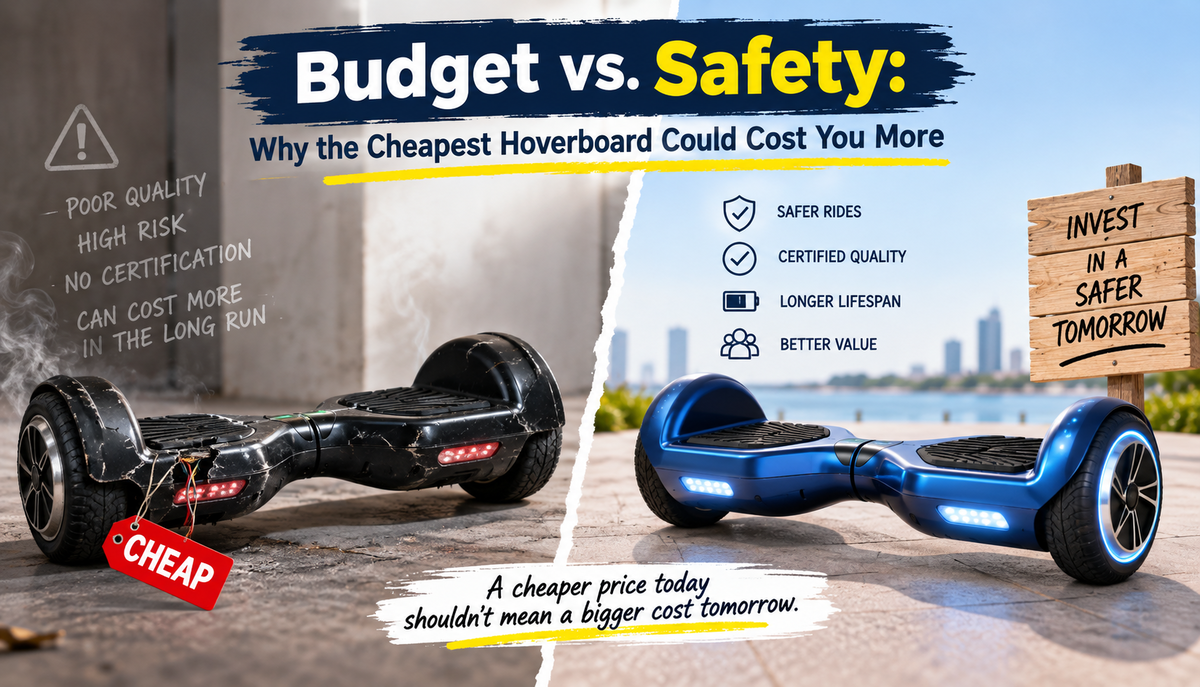
Budget vs. Safety: A Quick Comparison
| Ultra-Cheap / Uncertified Hoverboard | Certified Kids’ Hoverboard | |
|---|---|---|
| Upfront price | Lower | Moderate |
| Battery safety | Often unverified | UL2272 / SAA / CE certified |
| Speed for young riders | Rarely age-calibrated | Beginner-friendly speeds |
| Warranty | Usually none | 1-year standard warranty |
| Local support | Rare | Australian-based support |
| True cost over 12 months | Often higher (replacements, repairs) | Predictable, one-time cost |
So What Should a Safe, Budget-Friendly Hoverboard Actually Look Like?
You don’t need to spend a fortune to buy safely, you need to spend on the right things. Here’s what actually matters for a 6-year-old’s first hoverboard:
- UL2272, SAA, or CE safety certification – non-negotiable, full stop.
- A lower top speed setting, ideally around 6-10km/h for beginners, not a board maxed out for adult riders.
- A sturdy, non-slip 6.5-inch wheel base, which tends to be more stable and manageable for smaller riders than larger 8.5-inch or 10-inch boards.
- A local warranty of at least 12 months, so you’re covered if something goes wrong.
- Optional hoverkart attachment compatibility – for younger or more hesitant riders, a hoverkart bundle turns the hoverboard into a seated, hand-steered ride, which removes the balance requirement almost entirely while your child builds confidence.
A Smarter Way to Start: Hoverboard and Hoverkart Bundles
If your six-year-old has never ridden a self-balancing board before, jumping straight onto two wheels can be intimidating for them and for you. A hoverboard and hoverkart bundle solves this by converting the hoverboard into a seated, go-kart-style ride with hand controls for steering and braking.
It’s a genuinely practical middle step: your child gets the fun of an electric ride without needing balance and coordination from day one, and you get peace of mind knowing there’s a seat, a seatbelt-style grip, and hand controls involved rather than pure balance.
A Parent’s Pre-Purchase Checklist
Before you buy any hoverboard for a child aged 6–8, run through this quick list:
- Does the listing clearly state UL2272 (or equivalent) certification?
- Is there an Australian-based warranty of at least 12 months?
- Is there a specific speed or age recommendation for younger riders?
- Is customer support based locally, with a real contact method?
- Is a hoverkart attachment available if my child is a first-time rider?
- Does the seller have verifiable reviews from other Australian parents?
If you can’t tick at least four of these boxes, it’s worth reconsidering.
Final Thoughts
The cheapest hoverboard on the page is rarely the cheapest option once you count what happens after checkout — failed batteries, no warranty, an ill-fitted speed setting, and a disappointed kid whose new toy stopped working in a fortnight. A certified, age-appropriate hoverboard costs more upfront but saves you money, stress, and safety risk down the line.
Ready to shop safely? Browse Australia Hoverboards’ certified hoverboard range including boards built specifically for 6-to-8-year-olds, all backed by UL2272/SAA/CE certification, a 1-year warranty, and Australia-wide support.
Frequently Asked Questions
What is the safest hoverboard for a 6-year-old?
Look for a board that is UL2272, SAA, and CE certified, has a lower top speed suited to beginners, and ideally offers a hoverkart attachment for extra stability while your child learns.
Are cheap hoverboards from online marketplaces safe?
Not always. Many ultra-low-priced hoverboards skip formal battery safety certification, which increases the risk of overheating, and typically come with no local warranty or support.
What age is appropriate for a hoverboard?
Most safety-certified kids’ hoverboards are designed for riders aged 6 and up, provided the board has been specifically calibrated with lower speeds and stable balance settings for smaller riders.
Do hoverboards need to be certified in Australia?
While regulations continue to evolve, buying a hoverboard with UL2272, SAA, and CE certification is the clearest way to confirm the product has passed recognised electrical and fire safety testing.