Beginner to Pro in 30 Minutes: How to Master the Hoverboard (Plus Essential Safety Tips)
I. Introduction: The 30-Minute Path to Hoverboard Mastery
The self-balancing electric scooter, commonly known as the hover board or Swegway, represents a nexus of personal mobility and recreational fun. While the sight of a rider gliding effortlessly suggests complexity, the underlying technology—driven by advanced gyroscopic sensors—makes confident mastery remarkably quick. This guide is structured to transition a novice rider into a proficient user, capable of smooth movement and controlled turns, in approximately 30 minutes, without compromising the critical foundations of safety.
Achieving proficiency means moving beyond tentative balancing to confident maneuvering. High-performance boards, such as the Gyroor G2, offer tested speeds up to 9.9 MPH. However, maximising speed and attempting advanced tricks are secondary goals. The primary focus must remain on technique and adherence to stringent safety protocols.
Before any wheels turn, it is mandatory to address electrical safety. Past concerns regarding thermal incidents have been largely mitigated by modern manufacturing standards. For any consumer, particularly those in the market for reliable devices like the hoverboards australia market requires, verification of electrical certification is the non-negotiable starting point. Brands like Hoveroo hoverboard and Gyroor explicitly guarantee compliance with these rigorous standards.
II. Non-Negotiable Safety Foundations: The First 5 Minutes (Minutes 0-5)
The initial five minutes of the learning process are dedicated entirely to preparation, gear, and electrical safety validation. Skipping these steps compromises both rider safety and product longevity.
A. The Personal Protective Gear Checklist
The self-balancing technology is highly reliable, but human error and unexpected environmental factors necessitate protective equipment. A comprehensive checklist of protective gear is essential for mitigating injury risk.
Mandatory protective gear includes a properly fitted helmet, which is vital for safeguarding the head in the event of a fall or collision. Additionally, elbow and knee pads are essential for protecting joints from scrapes and bumps. Wrist guards are also crucial, providing support for the most common injury point when a rider instinctively extends their hands during a fall. Proper fit is paramount: helmets must sit securely without wobbling, and pads must fully cover the joints.
Beyond physical gear, footwear selection matters significantly. Riders must wear closed-toe shoes, which provide superior grip and stability on the board’s non-slip footpads.
B. UL 2272 Certification: Your Electrical Lifeline
The greatest historical concern surrounding self-balancing scooters related to battery and charging system failure, often resulting in thermal runaway and fire. This risk is managed today by compliance with the industry standard, UL 2272.
UL 2272 is the safety standard specifically designated for Electrical Systems for Personal E-Mobility Devices. This standard rigorously evaluates the safety of the electrical drive train system, which includes the battery, the charger system, and all internal electrical wiring. This comprehensive testing ensures the components can withstand conditions such as high temperatures, vibration, accidental drops from approximately one meter (simulating user handling), and even overcharging issues.
A consumer must always verify this certification. The verification protocol requires looking for the UL Mark on the product packaging and, most critically, locating the holographic certification label (sometimes referred to as the Enhanced Mark) affixed to the bottom of the device itself. Reputable models, such as the Gyroor Warrior and the Hoveroo hoverboard, explicitly feature this certification.
It is important to understand the scope of UL 2272: it certifies the safety of the device’s internal electrical systems. It does not, however, evaluate the performance, reliability, or rider safety related to human error. This distinction reinforces why protective gear remains non-negotiable—the certification protects against an internal electrical fire, but not against the rider falling.
C. Safe Riding Environments and Prerequisites
Choosing the correct practice area is critical for rapid learning and injury prevention. Riders should begin practice on flat, smooth pavement, ensuring the area is completely clear of debris, obstructions, or anything else that could precipitate an accident.
Rider suitability is governed by manufacturer recommendations. For instance, the high-performance Gyroor Warrior specifies a minimum recommended age of 6 years. Furthermore, riders must never exceed the maximum load capacity specified by the manufacturer, as this excessive strain negatively impacts the motor and battery life, and violates the safe operating parameters.
Finally, ensuring device longevity is an integral safety measure. Proper storage—a dry, room-temperature environment—is essential for lithium battery health. Batteries susceptible to failure due to improper maintenance or extreme temperatures are more likely to malfunction unexpectedly, which can lead to immediate loss of balance and rider injury.
III. Phase I: Mastering the Basics of Balance (Minutes 5-15)
The next ten minutes are dedicated to building basic muscle memory and developing trust in the device’s self-balancing capabilities.
A. Mounting with Confidence (5 Minutes)
The most common source of beginner anxiety is mounting the board. The procedure is structured to ensure the board remains stationary until the rider is fully aboard.
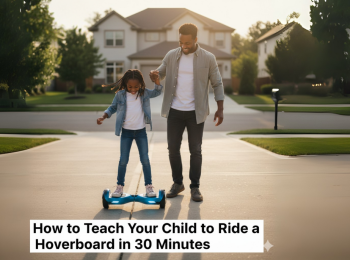
Initially, securing external support is highly recommended. The rider should stabilize themselves by holding onto a sturdy wall or the hand of an experienced adult or supervisor.
To mount, step onto the board one foot at a time. It is crucial to ensure the device remains completely flat and level during this process to avoid prematurely engaging the motors. The rider should then stand straight, distributing their weight evenly between both feet. Posture is key: knees should be kept slightly bent to act as natural shock absorbers, and the rider’s gaze should be fixed on a point straight ahead, not directed downward at the feet.
B. The Secret to Static Balance (5 Minutes)
Modern hoverboards employ sophisticated gyroscopic sensors that constantly work to keep the platform level. Once mounted, the rider’s task shifts from actively balancing to trusting the machine. The initial five minutes on the board should be spent standing still, recognizing that subtle ankle pressure, rather than large shifts in the hips or shoulders, is the control mechanism. The sensation should feel relaxed and centered.
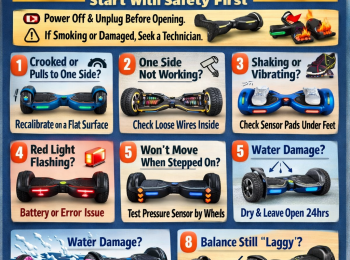
If the board feels uneven or twitchy despite the rider standing straight, it may require recalibration. This procedure is a fundamental troubleshooting step. The rider must ensure the board is resting perfectly level, then turn it off. The power button is then pressed and held for approximately 5 to 10 seconds. The red indicator light will typically illuminate and flash five times. Once the red light ceases blinking, the board can be restarted, resetting the balance sensors for optimal performance.
C. The Safe Dismount Technique (Non-Negotiable)
The dismount is arguably the most critical maneuver for a new rider. An incorrect dismount is a leading cause of initial falls, as the rider’s action can trigger unintended acceleration.
The non-negotiable technique is the backwards exit. The rider must shift their primary weight onto their dominant foot, and then step backward off the board with the non-dominant foot.
Stepping forward off the device poses a significant risk. The pressure exerted by the forward-stepping foot is interpreted by the internal sensors as an input to accelerate forward. This causes the hoverboard to shoot away from the rider, potentially sweeping the other foot out from underneath them and resulting in an uncontrolled fall. Until this backwards motion becomes instinctive, riders should continue to hold onto a wall or stationary object.
IV. Phase II: Gaining Momentum and Direction (Minutes 15-30)
With stability achieved, the rider can now introduce momentum and direction, completing the beginner-to-intermediate transition within the promised 30-minute window.
A. Moving Forward and Reverse (10 Minutes)
Movement on a self-balancing scooter is controlled by the direction and degree of pressure applied through the ankles, leveraging the self-balancing gyroscopic system.
To initiate movement, the rider applies subtle, gentle pressure forward with both ankles simultaneously. Leaning forward slightly moves the board ahead. Conversely, leaning back slightly slows the device down or initiates reverse movement.
Crucially, movements must be smooth and consistent. Jerky inputs confuse the sensors and can lead to instability. New riders should keep their speed moderate—well below the maximum speed of even entry-level models like the Jetson Spin (6.7 MPH) or the Gotrax Edge (5.9 MPH). Many beginner models, including the Hoveroo hoverboard, are equipped with speed limit alerts to ensure safer cruising speeds during the learning phase. By maintaining a straight, relaxed posture with slightly bent knees, the rider enables their body to work seamlessly with the board’s continuous micro-adjustments, ensuring a fluid ride.
B. Introduction to Turning (10 Minutes)
Turning is achieved through differential pressure application. To turn, the rider applies subtle pressure to one side of the board while keeping the other side neutral or slightly resistant. For instance, to execute a right turn, the rider gently pushes the right ankle forward while easing the left ankle slightly backward or keeping it neutral.
The focus must be on executing smooth transitions from straight movement into controlled curves. Rapid or sharp inputs are discouraged, as they can cause loss of control. To develop proficiency, riders are advised to practice large figure eight patterns in an open area, which develops the necessary coordination for transitioning between turns, acceleration, and deceleration.
V. The Pro Transition: Advanced Maneuvers and Terrain Mastery
Once basic controlled movement is established, the rider can begin to explore advanced maneuvers and terrain navigation, elevating their skill set to a proficient level.
A. Mastering the 360-Degree Spin (The Signature Move)
The ability to spin 360 degrees in place is a definitive signature of advanced control. Achieving this requires a progression from the basic 180-degree rotation.
The technique relies on applying complex, simultaneous, differential pressure known as the toe-heel technique. To initiate the spin, the rider applies pressure using the toes of one foot and the heel of the opposing foot. For instance, pushing down with the right foot’s toes and the left foot’s heel initiates a spin in one direction. This technique utilizes the board’s independent motor systems to rotate on its central axis.
For safety and precision, the rider must maintain a level body posture throughout the movement, focus on making the rotation continuous, and practice “spotting the landing,” or keeping their gaze fixed on a reference point during the spin to prevent disorientation.
B. Advanced Technique for Challenging Terrains
While standard hoverboards are best suited for paved surfaces, powerful models are specifically designed for varied environments. Models like the Gyroor Warrior 8.5 inch all terrain off road hoverboard utilize robust construction, high-powered 700W dual motors, and solid 8.5-inch tires to manage difficult ground.
When navigating terrains such as grass and gravel, maintaining a moderate, controlled speed is essential. The rider must constantly adjust balance by subtly leaning forward or backward based on the slight changes in incline and surface friction. For steep inclines (up to 30° on the Gyroor off road hoverboard ), leaning slightly forward helps maintain stability and traction.
For more challenging rocky surfaces, the speed must be significantly reduced. The rider should utilize bent knees extensively to absorb shocks, effectively using their legs as the primary suspension system to maintain stability and prevent sudden displacement.
C. Advanced Trick Repertoire
Advanced riders may pursue stunts such as the Rebound, the Sit Down Rotate, and the Hoverboard Dial. It is critical that any attempt to perform such sophisticated moves, including short “jumps” or rapid 360 spins, must be executed only in a safe area and strictly under the supervision of an adult or trained professional.
VI. The Ultimate Buyer’s Guide: Finding Your Perfect Ride
Selecting the appropriate hoverboard involves balancing desired performance features (speed, range, off-road capability) with safety standards and the rider’s specific skill level and age.
A. Understanding Hoverboard Segments
The market is generally divided into three major segments:
Performance/Off-Road: Characterized by large wheels (8.5 inches or more) and high-wattage dual motors (700W+), suitable for heavy riders and varied terrain.
Beginner/Youth: Defined by lower speeds, lighter weight, and specific features like child modes and lower maximum load limits, making them the best hoverboard for kids.
Commuter/Utility: Focuses on maximizing range and comfort, often featuring durable construction and reliable connectivity.
B. Brand Deep Dive and Model Comparisons
An analysis of market leaders reveals a strong consensus around performance and safety compliance.
Gyroor models frequently top “Best Overall” lists, demonstrating robust engineering. The Gyroor G2 is a prime example, boasting 700W motors and a maximum load of 265 lbs, suitable for adults and demanding use. For rugged use, the gyroor warrior provides superior off-road capability. Gyroor also caters effectively to younger users with models like the Gyroor G13, optimized for children aged 6 to 12 years.
Hover-1 offers competitive devices. The Hover-1 Titan is noted for comfort and durable wheels. The hover x1 (also marketed as hover 1 x) is an entry-level utility board, often featuring Bluetooth and a solid weight capacity of 220 lbs. Some specifications claim a remarkable range of up to 12 miles on a single charge for the Hover-1 X1.
For the Australian market, the Hoveroo hoverboard stands out as a highly certified, beginner-friendly option. It features dual 250W motors, an IPx4 water-resistant rating, and UL2272/SAA/RCM compliance, offering an extended range of 10 to 15 kilometers (6.2 to 9.3 miles) per charge and numerous safety features like fall detection and speed limit alerts. Further cementing trust in local suppliers, the brand is recognized as an approved supplier to major national retailers including Harvey Norman, Kogan, Mydeal, Woolworths, and BigW.
For riders requiring maximum simplicity and budget-friendliness, models such as the Gotrax Edge and Jetson Spin are highly recommended as the most beginner-friendly and affordable options.
Comparative Specifications of Leading UL 2272 Certified Hoverboards
| Model Name | Wheel Size | Motor Power | Max Load | Usability per Charge | Charging Time | Current/Sale Price | Original Price |
| Australia Hoverboard Off Road Hoverboard NS8 (Camouflage Grey / Camouflage Blue) | 8.5-inch 1 | 2 x 350W motors 1 | Not listed | 1 to 1.5 hrs 1 | 2-3 hours 1 | $499.00 ($469.00 with code XMAS30OFF) 1 | $799.00 1 |
| Australia Hoverboard Off Road Hoverboard NS8 (Black, PRE-ORDER ONLY) | 8.5-inch 1 | 2 x 350W motors 1 | Not listed | 1 to 1.5 hrs 1 | 2-3 hours 1 | $469.00 1 | $899.00 1 |
| GYROOR G13 Off Road Hoverboard (PRE-ORDER ONLY) | 6.5 inch Off-Road | 2 x 250W (500 W Dual System) | 80 kg | Not listed | Not listed | Not listed | Not listed |
| 6.5 HoveroorX Australia Off Road Hoverboard (Electric Galaxy Blue / Electric Blue, PRE-ORDER ONLY) | 6.5 inch 1 | Not listed | Not listed | Not listed | Not listed | $229.00 1 | $599.00 1 |
| Australia Hoverboard 8 inch Hoverboard (Lamborghini Style, Purple, PRE-ORDER ONLY) | 8 inch 1 | Not listed | Not listed | Not listed | Not listed | $299.00 1 | $699.00 1 |
| Australia Hoverboard 6.5 inch Self Balancing Electric Scooter | 6.5 inch 1 | Not listed | Not listed | Not listed | Not listed | $299.00 1 | $599.00 1 |
Note: Tested speeds and ranges typically reflect a 175 lbs (79 kg) rider under optimal conditions. Claimed ranges (as often seen with the hover x1) may be higher than real-world results.
C. Aesthetic Choice: Finding Your Color
Hoverboards are available in a vast array of colors and finishes. Consumers seeking a stylish finish can typically find options across the spectrum. The Gyroor Warrior is notably available as a blue hoverboard. Other popular colors include the purple hoverboard, available from brands like Australia Hoverboards. Standard colors such as black hoverboard and white hover board are universally available. For premium aesthetics, the gold hoverboard (or hoverboard golden finish) is offered by manufacturers like Hover-1 (Astro Black Gold) and GlareWheel.
D. Adjacent Micromobility: Gyroor and Hoveroo Scooters
For consumers interested in related personal electric vehicles, self-balancing board manufacturers also produce electric scooters. The gyroor electric scooter segment is robust, with models like the C1S featuring powerful 550W or 800W motors and high durability. While the advertised range for the Gyroor C1S may be up to 20 miles, real-world testing typically yields 10 to 12 miles on a charge, reinforcing the need to halve manufacturer claims for realistic commuting expectations. Similarly, the hoveroo electric scooter is often praised by parents for its sturdy build and suitability for younger children.
VII. Longevity and Maintenance: Sustaining the Ride
Proactive maintenance, especially concerning battery charging and storage, significantly determines the lifespan and operational safety of the hoverboard.
A. Safe Charging Practices for Battery Longevity
The original electrical safety concerns necessitate disciplined charging habits. The first mandate is to use only the charger provided with the hoverboard or a manufacturer-approved replacement. Use of incompatible chargers is a major source of electrical hazard and damage.
Overcharging must be avoided. The hoverboard should never be left plugged in overnight or for more than a short period after the charging indicator light turns green (charging times typically range from 1.5 to 3 hours, such as the 1.5 to 2 hours required for the Gyroor Warrior ). Leaving a lithium battery constantly plugged in strains its components and accelerates degradation. Furthermore, charging must be done in a safe location, away from flammable objects like curtains or paper, and never left unattended.
Temperature control is paramount. Both charging and storage should occur indoors at moderate room temperature, ideally between 50°F (10°C) and 77°F (25°C). Extreme heat or freezing cold temperatures rapidly shorten the life of lithium batteries. For long-term storage (30 days or more), the battery should be charged to approximately 50% capacity and stored in a cool, dry place to prevent degradation.
B. Troubleshooting: Decoding the Red Flashing Light
Hoverboards communicate internal errors through a sequence of red flashing lights. Before diagnosing a mechanical failure, the rider should first attempt the recalibration reset described in Phase I.
If the error persists, the flashing sequence provides a precise diagnosis of the faulty component:
3 Flashes: Indicates a problem with the sensors, which frequently results in the board feeling lopsided or unbalanced.
4 Flashes: Suggests a fault with the internal motor on the motherboard side. This often requires replacing the entire motor, which comes assembled within a new wheel.
6 Flashes: Signals a bad battery that needs replacement.
7 or 8 Flashes: Indicates an issue with the gyroscopes, requiring replacement of the gyroscope unit, sometimes as part of a full circuit board kit.
This diagnostic specificity allows users to target repairs precisely, optimizing maintenance efforts.
C. Routine Mechanical Inspection
Regular inspection ensures optimal performance. This includes checking the wheels and axles for mechanical obstructions or debris, inspecting the footpads for sensor cleanliness or damage, and verifying that the internal wires and connections, especially those connecting the motor to the main board, are secure.
VIII. Conclusion: Staying Safe and Riding Smart
The goal of achieving proficiency on a self-balancing scooter in 30 minutes is highly attainable through controlled, disciplined practice focused on ankle articulation and weight transfer. This mastery allows riders to fully enjoy the capabilities of modern devices, from controlled sidewalk cruising on a certified Hoveroo to trail navigation on a powerful Gyroor Warrior.
The longevity and safety of the experience, however, depend entirely on adherence to two fundamental principles: electrical certification and responsible operation. The procurement of a UL 2272 certified device eliminates the core risk of internal electrical failure. This must be coupled with the consistent use of full protective gear (helmet, pads) to manage the risk associated with rider error. By following these protocols and maintaining vigilant charging habits, the experience remains safe, exhilarating, and sustainable for the long term.